Lunar Notes
(i) Lunar Eclipse 17th August 1989
This eclipse was viewed from a back garden of a house in Haig Avenue, Canford Cliffs, Poole, Dorset. The instrument used was a pair of Celestron 11 x 80 tripod mounted binoculars. All times were recorded by ordinary clock time. The orientation of the points of the compass in relation to the moon are the standard IAU conventions. The umbra first appeared in the north west of the moon's disc.
2.35 am - The west edge of the Sinus Iridium was reached by the umbra (The left hand edge of the bay).
2.37 am - Aristarchus and Grimaldi were visible in the darkened sector of the moon.
2.38 am - Sinus Iridium totally covered by the umbra.
2.40 am - Umbra has reached Copernicus.
2.44 am - Plato also reached. (Note the moon seems to be like the young moon with its earthshine except that the illuminated phase is much larger tonight).
2.50 am - I estimate that half of the moon's disc is covered by the umbra.
2.54 am - Moon occults star! - south of Grimaldi. The moon moved eastwards to occult the star, that is the moon moved towards the left against the starry background. Therefore the moon's west limb precedes its east.
2.55 am - Orange tinge in area north west of Aristarchus.
2.57 am - Tycho reached by the umbra. (Note - the earth's shadow is definitely curved and its circumference is far larger than the moon's).
3.00 am - The garden is obviously not so well moonlit. The stars are far more obvious to the naked eye than they were.
3.02 am - The Aristarchus area is orange, but the Grimaldi and Sinus Iridium areas are yellow. To the naked eye the moon has a strong orange tinge.
3.05 am - Moon covered by cloud, the M31 Andromeda Galaxy seems to be visible to the naked eye.
3.06 am - The umbra has reached Censorinus.
3.13 am - The umbra has totally immersed the Mare Crisium.
3.15 am - Green colour band noted between the orange "dark" portion of the moon and the remaining brightly illuminated sliver of moon.
3.21 am - The moon appears totally immersed. There is a yellow sliver at the south east limb. The bulk of the moon is orange.
3.23 am - The moon appears a diffuse orange/red and also a yellow colour. The Pleiades and M31 are visible to the naked eye.
3.32 am - I saw a naked eye satellite heading towards the north pole.
3.35 am - Only the maria are visible except perhaps for the lighter tint of the Tycho ray system.
3.38 am - Another polar naked eye satellite.
3.39 am - The moon appears less orange now, more a murky yellow/orange colour.
3.46 am - M31 in Andromeda and M33 Triangulum galaxy visible in binoculars.
3.47 am - The moon continues to be a dull copper colour with the south east limb is yellower and lighter.
3.50 am - Moon deeply eclipsed still. Dumbell nebula visible in the binoculars.
3.53 am - The yellow, lighter limb is diminishing, the moon is of a more uniform brightness and a more uniform copper colour.
(ii) Total Eclipse Of The Moon - 3rd March 2007
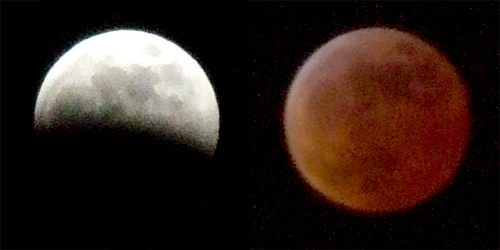
My first lunar eclipse since 1989 and it was certainly worth the wait. All week I had been expecting the clouds to roll in over Forest Row but tonight was very clear indeed. The eclipse was stunning, with the moon hovering below Leo. Once the eclipse neared totality the moon looked like a giant amber glass paperweight lit up from underneath, translucent orange and yellow. In my Celestron 11x80s the craters were invisible, but the seas were clearly laid out on an apparently smoothed and simplified surface. The moon appeared to hang in front of the background stars in three dimensions, a domed disc viewed from above rather than a globe, indescribably delicate and ethereal.
I used my quite basic digital camera with its zoom lens set to its longest focal length. The results are not perfect, but they will always remind me of tonight's wonderful binocular sight: