Objects for April, May and June
Bootes
Arcturus
"There is always the comfort, when seeing Arcturus rising in the east in the late evening, that winter has not long to go; and by the time it disappears into the evening twilight, the long warm days have arrived" [Muirden, p112]
Distance: 36.7 light-years [Karkoschka p84]. Arcturus is "a lovely light orange, so that in binoculars it its beautiful" [Moore, Binoculars, p 61]. Arcturus is not much more massive than the sun although it is around 25 solar diameters across (and takes two earth years to turn on its axis) - it is also older at around 7 billion years [3]. According to Burnham (p302) we receive heat from Arcturus equivalent to that produced by a candle five miles away! Arcturus is a Population II halo star driving through the plane of our Milky Way at a steep angle compared to the main galactic disk [4]. This means that Arcturus is moving quickly relative to the earth, and only attained naked eye visibility here half a million years ago, and will fade to become invisibie to the eye again in another half a million years time [Burnham p303]. Arcturus moves relative to the background stars at a rate of one degree every 16 centuries [Muirden p112].
Arcturus' motion has led Navarro, Helmi and Freeman to suggest that Arcturus may have been born inside another galaxy, a dwarf galaxy subsequently absorbed to help form the halo of our Milky Way billions of years ago [4]. Arcturus no longer synthesizes hydrogen, instead building heavier elements such as carbon, nitrogen and oxygen. Eventually Arcturus will run out of helium, and will eject its outer layers and leave only a white dwarf [5], our own sun will undergo a similar transformation [6].
Famously Arcturus' light was used to trigger a photoelectric switch opening Chicago's 1933 World’s Fair, the "look back" time was believed to be the same as the time elapsed since 1893's World Fair, symbolicially joining the two exhibitions [5].
Cancer
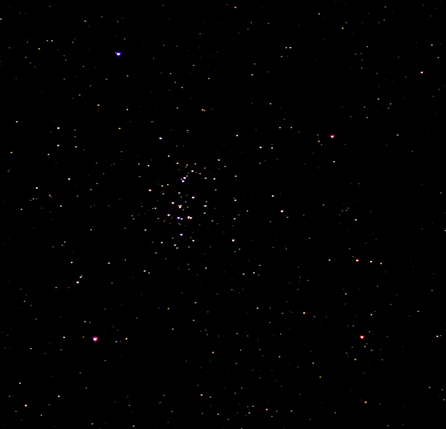
Beehive M44 (Praesepe)
Open cluster of around 1000 bright young stars located 600 light years from earth [1]. Its diameter is around 15 light-years [2]. M44 may well share a common origin with the Hyades [31]. The cluster was famously first resolved by Galileo.
Canes Venatici
Cor Caroli - Charles' Heart
Distance: 108 light-years [Karkoschka p38]. Full name is "Cor Caroli Regis Martyris" after Charles I [19]. Cor Caroli is telescopically a double star with an orbital period of at least 8300 years. One component star is far brighter than the fainter one, the former being a "magnetic star" with huge long-lasting sunspots [33] - (a) magnetic star with a magnetic field 1500 times the strength of the Sun's." [35]
Chara
Distance: 27.6 light-years [Karkoschka p38]. According to Jim Kaler "Chara provides a modestly good chance to see what the Sun would look like at stellar distances..." [32]. Chara's (a class G dwarf) temperature and radius are similar to that of our sun, and it is only 18 percent brighter than our star [32].
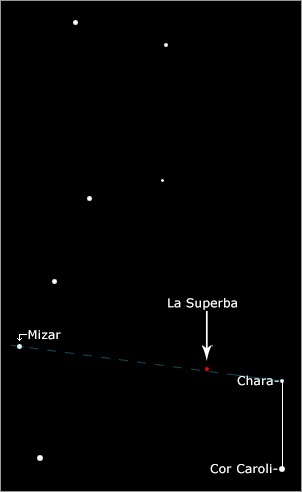
Y Canum Venaticorum - La Superba
Distance: 830 light-years [Karkoschka p38]. "...as it is among the brightest of the 'carbon stars' ... here carbon ... (is) lofted to the surface before escaping into space. Huge absorptions by carbon molecules ... (gives) the star a remarkable spectrum, a combination of them cutting out blue and violet light and making the star quite red ... La Superba is the sky's brightest 'J star'... (a rare type of carbon star with) a huge elevation of the heavy isotope of carbon, carbon- 13 ... no one quite knows how J-stars are actually made. Go look for this red denizen of the northern skies, its red color obvious in binoculars, and gaze in wonder at one of the sky's rarer sights." [35].
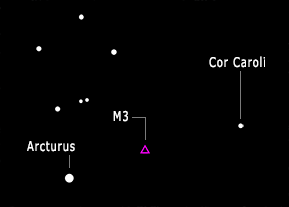
Globular Cluster M3
Distance: 34,000 light-years [Karkoschka p84]. Visible to the naked eye and "a superb object with the slightest optical aid... In binoculars, it appears just like a hazy, nebulous patch" [28]. Contains over 500,000 stars [26] and is eight billion years old [27].
Galaxy M51 - The Whirlpool
Distance: 25 million light-years [Karkoschka p38]. In the photo below you can see both M51 and the smaller galaxy NGC 5195. The gravitational encounter between these objects is producing tidal forces triggering new star formation in M51 [29]. M51 lies about half a binocular field west-southwest of Alkaid (Eta Ursa Majoris) … to see NGC 5195 you will require at least 10×50 binoculars and a steady sky [30].
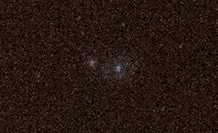
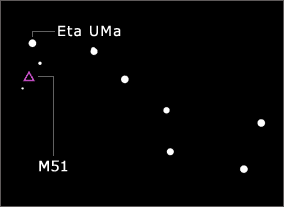
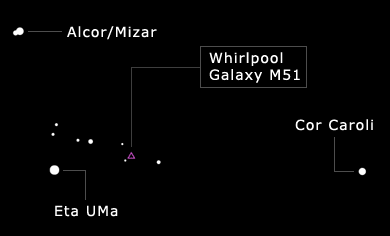
I have seen M51 with 7x50s and averted vision as a small grey smudge of light, much more compact than I expected.
Coma Berenices
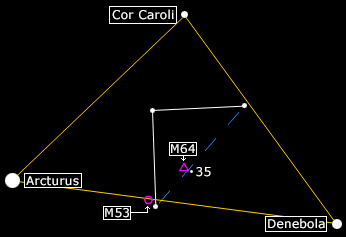
A constellation lying in the triangle between Cor Caroli, Arcturus and Denebola [Muirden p118]. Constellation formed by Tycho Brahe [Moore, Stargazing p65]. The Coma Star Cluster has a diameter of 22 light-years and is only 250 light-years away located in the galactic disc [Crossen p94]. There has been some academic disagreement as to the age of the cluster, but a 2020 determination is 590 million years give or take 40 million [21]. Crossen [p94] tells us the cluster has lost a lot of low mass stars in its three circuits around the galactic center, and that it is now close to the point where the mutual attraction of cluster stars only just counterbalances the pull of other material in our galaxy - the Coma cluster is on the verge of falling apart.
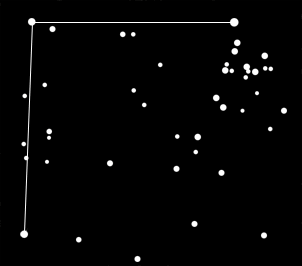
M64 Black Eye Galaxy
Distance: 20 million light-years [Karkoschka p78]
"... easily found north-east of a mag. 5 star, a small and bright nebulosity with a central condensation" [Muirden p119]. "...can be located in a finderscope or 10 x 50 binoculars" and "In order to give yourself the best chance of observing it wait for M64 to reach close to culmination on a moonless night and transparent night" [22].
M53 Globular Cluster
Distance: 60,000 light-years [Karkoschka p78]
Corona Borealis

A truly ancient constellation, it appears as 14,000 year old cave art (Cueva di El Castillo) [16]. In Neolithic Europe the constellation may have been depicted by open-sided stone circles - a possible example can be found at Kerlescan near Carnac [17]
Draco
“Most of Draco lies well off the Milky Way, and therefore is rather poor in interesting objects” [Crossen, p106].
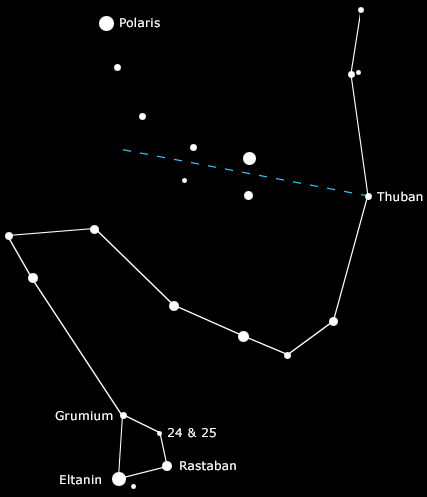
Head of Draco
The Head of Draco consists of Rastaban (beta), Eltanin (gamma), Grumium (Xi) and 25 + 25 Draconis (nu). According to Karkoschka (p42) the distances are Rastaban (380 light-years), Eltanin (154 light-years), Grumium (112 light-years) and 24 + 25 Draconis (99 light-years).
Thuban
“Thuban …. (was) almost exactly at the pole in 2700 BC” [18].
Hydra
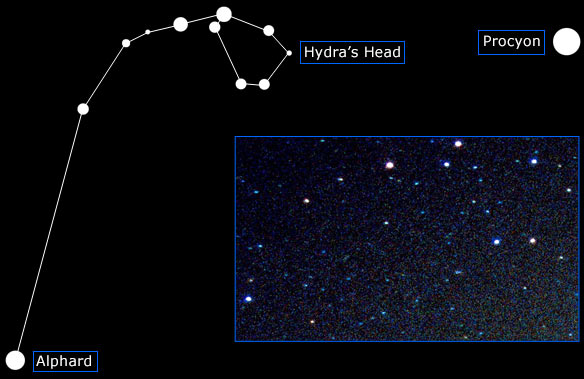
[Diagram below left shows the northernmost part of Hydra, the photo to the right of this is of Hydra's Head]
Alphard
Distance: 180 light-years [Karkoschka, p72]. "Castor and Pollux act as pointers to Alphard" [Moore, Stargazing, p67]. Pale orange giant spinning with an equatorial speed of 3.3 kilometers per second, taking 2.4 years to rotate around once! [15].
Leo
Regulus
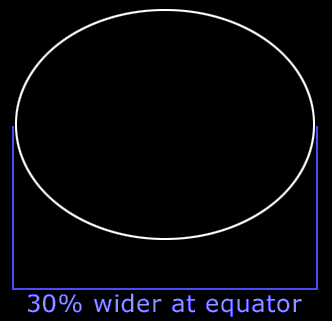
Distance: 79 light-years [Karkoschka, p74]. Regulus has a diameter around 4.3 times our sun [8]. Named by Copernicus, Regulus appears in binoculars as a fine silver-blue colour [Crossen p89]. "While almost all cool stars rotate slowly, rapid rotation is the norm for hot stars" - Regulus is spinning at 96% of its critical speed for breaking up, stretching the equatorial radius to about 130% of the polar dimension.[7]. The star rotates at 317 km/s [8] and completes one spin in 15.9 hours [9]. We see Regulus almost equator-on [7].
Galaxies M65 and M66
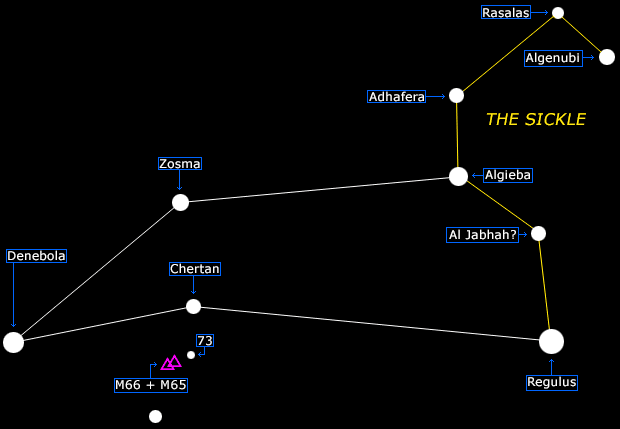
Distance: M65 35 million light-years [Karkoschka, p74]. M66 Distance: 35 million light-years [Karkoschka, p74]. According to Astronomy Now "Under a dark sky, binoculars will show them as two roughly magnitude 9 glows 20' apart. [23]. Muirden [p125] describes the two close galaxies as "a somewhat extended nebulous patch". I have never been able to find these two with binoculars, but I will keep looking!
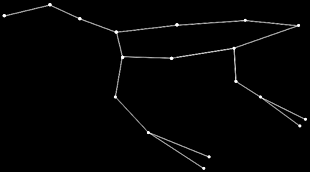
Ursa Major
|
"It is even thought possible that the constellation actually got its name 50,000 years ago when a Paleolithic bear cult existed" [34]. |
|
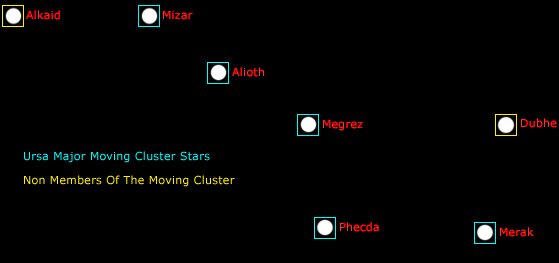
| Distance* | Distance* | |||
| Alkaid | 104 | Phecda | 83 | |
| Mizar | 81 | Dubhe | 123 | |
| Alioth | 82 | Merak | 80 | |
| Megrez | 81 |
*Distances in light-years taken from p34 of Karkoschka
Galaxies M81 and M82
"... two galaxies in the same field of view" [Muirden p138].
"There are two particularly interesting galaxies in Ursa Major: the spiral M81 and the irregular M82, which is a well-known radio source" [Moore, Binoculars, p142].
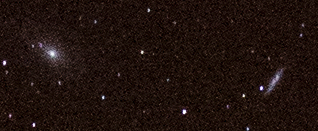
Distance: M81 - 12 million ly, M82 - 13 million ly [Karcoschka p32].
M81 (Bode's Galaxy) This "stately spiral" is one of the brightest galaxies in the night sky [14].
M82 (Cigar Galaxy) is a starburst galaxy due to its gravitional interactions with M81 (Bode's Galaxy)- [11]. M82 "is famous for its spectacular bi-polar outflow or "super-wind", gas and dust driven outwards by stellar winds and supernovae in the galaxies central regions, where stars are produced at a very high rate". [13]
These two galaxies will eventually merge [12].
| To find M81 & M82 mentally draw a line from Phecda through Dubhe (Step 1) and extend this line out the same distance beyond (Step 2). This takes your eye to a solitary star very near to the galaxies. |
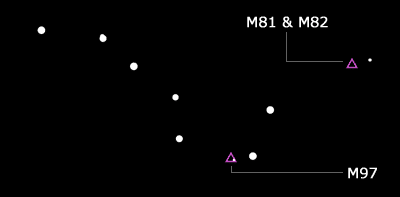
Planetary Nebula M97 (Owl Nebula)
Distance: 2500 ly [Karkoschka p34]. I have not seen this object myself yet. According to Muirden (p138) this planetary nebula appears in 12x glasses as a dim, circular, evenly-illuminated patch with well-defined margins.
Here is a link to a map showing some suggested lines of sight for finding the most interesting objects in Ursa Major and Canes Venatici.
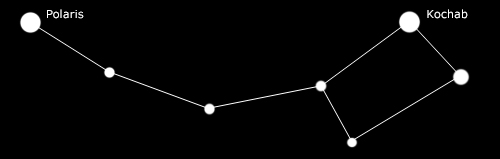
Ursa Minor
Polaris
Distance: 430 light-years [Karkoschka p22].
Kochab
Distance: 131 light-years [Karkoschka p22]. Kochab appears to gain brightness in moonlight [Muirden p138]. Kochab is orbited by a large planet more than six times as massive as Jupiter [10]
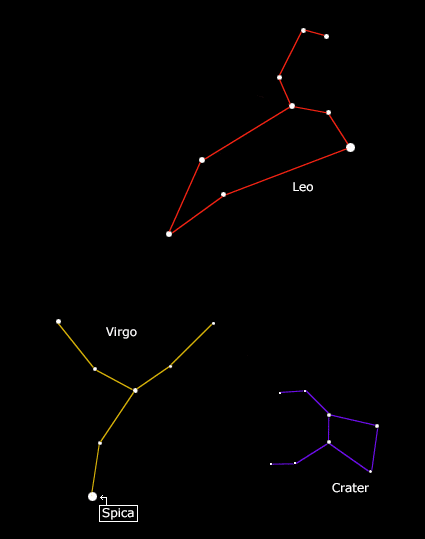
Virgo
Spica
Distance: 250 light-years [Karkoschka p86]. Spica can be found by continuing the (curved) line from Ursa Major's tail through Arcturus [Moore, Stargazing p62]. Spica is a "spectroscopic" binary made up of two blue dwarf stars [25]. These orbit each other in only 4 days, at a distance of around twenty-eight solar-radii. This puts them so close together that their mutual gravity tidally distorts their atmospheres, with the result that the stars are not spherical [24]. Winds from both stars collide violently producing large amounts of x-ray light [25].
|
Footnotes [1] “Messier 44 - NASA Science.” NASA, NASA, 25 Mar. 2025, science.nasa.gov/mission/hubble/science/explore-the-night-sky/hubble-messier-catalog/messier-44/ [2] Todd, Iain. “Beehive Cluster, M44.” BBC Sky at Night Magazine, 29 Apr. 2025, www.skyatnightmagazine.com/astrophotography/stars/star-clusters/beehive-cluster [3] Ventrudo, Brian. “Arcturus - a Star on the Move.” Arcturus - A Star on the Move - by Brian Ventrudo, Seeking Starlight, 20 June 2024, www.seekingstarlight.com/p/arcturus [4] Alles over Sterrenkunde, www.allesoversterrenkunde.nl/!/!/actueel/artikelen/_detail/gli/did-another-galaxy-send-us-arcturusr/. Accessed 17 Feb. 2026. [5] Arcturus: Interesting Facts about the Dying Red Giant, universemagazine.com/en/arcturus-interesting-facts-about-the-dying-red-giant/. Accessed 17 Feb. 2026. [6] “Starwatch: Arcturus Offers a Glimpse of Our Sun’s Future.” The Guardian, 7 Oct. 2018, www.theguardian.com/science/2018/oct/07/starwatch-arcturus-offers-a-glimpse-of-our-suns-future. [7] Che, X., et al. “Colder and Hotter: Interferometric Imaging of ß Cassiopeiae and a Leonis.” arXiv.Org, 4 May 2011, arxiv.org/abs/1105.0740. [8] Lawrence, Pete. “A Guide to Regulus, the Brightest Star in Leo.” BBC Sky at Night Magazine, 2 Feb. 2026, www.skyatnightmagazine.com/advice/regulus. [9] Orbit of Regulus, iopscience.iop.org/article/10.1086/591148/fulltext/22909.text.html. Accessed 24 Feb. 2026. [10] Atkinson, Stuart. “Ursa Minor, the Little Dipper.” BBC Sky at Night Magazine, 17 Apr. 2024, www.skyatnightmagazine.com/advice/ursa-minor. [11] “Home.” Click for Main Menu, kielderobservatory.org/news/latest-news/342-what-s-up-may-24. Accessed 9 Mar. 2026. [12 https://www.researchgate.net/publication/347863376_ [13] www.herschel.caltech.edu/image/nhsc2009-021d. Accessed 9 Mar. 2026. [14] science.nasa.gov/mission/hubble/science/explore-the-night-sky/hubble-messier-catalog/messier-81/. [15] http://stars.astro.illinois.edu/sow/alphard.html [16] http://news.bbc.co.uk/1/hi/sci/tech/871930.stm [17] Burl, Aubrey. Prehistoric Avebury. Yale University Press, 2002. pp 168-9 [18] http://stars.astro.illinois.edu/sow/thuban.html [19] http://www.ianridpath.com/startales/canesvenatici.html [20] https://www.star-facts.com/la-superba/ [21] https://academic.oup.com/mnras/article/497/3/2562/5873019 [22] https://astronomynow.com/2023/05/15/make-eyes-at-messier-64-the-black-eye-galaxy/ [23] https://www.astronomy.com/observing/101-must-see-cosmic-objects-m65-and-m66/ [24] https://www.cfa.harvard.edu/news/understanding-spica [25] http://stars.astro.illinois.edu/sow/spica.html [26] https://science.nasa.gov/mission/hubble/science/explore-the-night-sky/hubble-messier-catalog/messier-3/ [27] https://esahubble.org/images/potw1914a/ [28] http://www.messier.seds.org/m/m003.html [29] https://science.nasa.gov/mission/hubble/science/explore-the-night-sky/hubble-messier-catalog/messier-51/ [30] https://www.astronomy.com/astronomy-for-beginners/10-top-spring-binocular-treats/ [31] http://www.messier.seds.org/xtra/ngc/hyades.html [32] http://stars.astro.illinois.edu/sow/chara.html [33] http://stars.astro.illinois.edu/sow/corcaroli.html [34] https://www.aavso.org/myths-uma [35] http://stars.astro.illinois.edu/sow/lasuperba.html |